Hospitals have spent heavily on hiring software. Workday, iCIMS, Oracle, SAP SuccessFactors — the platforms are sophisticated, the data is there, and the dashboards show exactly where the pipeline stands.
And yet the pipeline still stalls.
A vacant healthcare position costs a hospital an average of $8,000 per day. Left unfilled for three months, that figure climbs to $14,000 daily, according to Healthcare Finance data compiled by Medix.¹ With 83 days as the average time to recruit an experienced RN,² the math is unambiguous: slow hiring is an expensive problem.
The sourcing side has improved. Job boards are optimized. Screening is faster. Candidates are in the pipeline.
The stall happens somewhere else. According to GoodTime's 2026 Hiring Statistics Report, hiring slowdowns in healthcare are driven primarily by interviewer capacity and follow-through — not by sourcing.³ The most frequently cited bottleneck: delays at the stage where decisions depend on busy clinicians and managers balancing hiring responsibilities with their core operational work.
In other words: the hiring manager never responded.
The Person Who Owns the Decision Is Never at a Desk
In most industries, a hiring manager is a team lead or department head who spends a significant part of their day at a computer. A notification comes in, a resume lands in the queue, they open it. The friction is low.
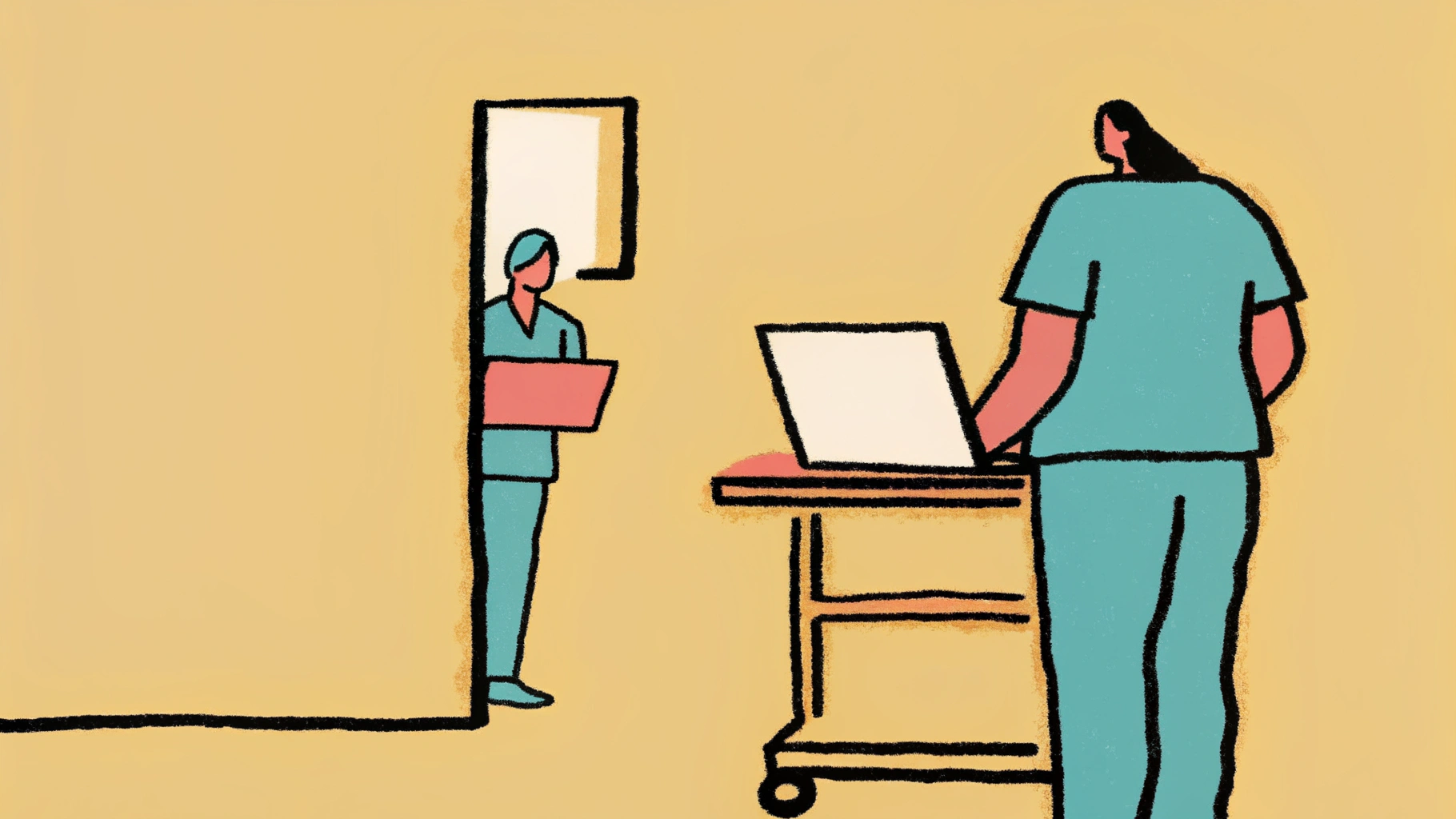
Hospital hiring managers are different. A nurse manager running a unit is managing patient assignments, handling escalations, covering gaps when staff call out, and making clinical decisions throughout their shift. Logging into an HR system to review a candidate is not part of their workflow — it's an interruption to it.
The numbers bear this out. Some nurse managers report spending up to 49% of their work time on deskwork, according to research published in the CIN Journal.⁴ But that deskwork is scheduling, documentation, and staffing coordination — not HR system reviews. A Harris Poll survey found that clinicians spend nearly 28 hours per week on administrative duties.⁵ The ATS is not where that time goes.
HR Cloud's 2026 analysis of hospital HR software put it plainly: hospitals operate with "frontline staff who never sit at a desk" as a baseline condition — not an exception.⁶
The ATS was not designed for this. Most HR software was built around office environments where employees have consistent computer access throughout the day. For those organizations, a hiring manager missing a review queue is a minor inconvenience. The role can wait. Someone will get to it.
Why Hospitals Are Different
In a hospital, empty roles don't wait quietly.
When a position goes unfilled, someone covers the gap. Existing staff work overtime. Agency nurses get called in at rates that can run significantly higher than staff pay. According to Jobvite data, 56% of recruiters identify hiring managers moving candidates through stages too slowly as their biggest bottleneck — and 43% specifically cite slow resume review.⁷
The current generation of ATS platforms records this delay. The dashboard shows how long a candidate has been sitting in the hiring manager review stage. The data is visible.
But visibility alone doesn't move the process forward. The hiring manager who hasn't logged in to review a candidate hasn't seen the notification. The delay accumulates not because anyone decided to slow things down — but because the system requires a login that never happens.
For office-based organizations, this is a friction problem. For hospitals, it's a cost problem. Every day a role stays open is a day someone pays for it — in overtime, in agency spend, or in care quality absorbed by an understaffed unit.
What the Problem Actually Requires
The fix isn't a better dashboard. The hiring manager already isn't looking at the current one.
What the problem requires is a system that reaches the hiring manager where they already are — on their phone, between patient rounds — and asks for a decision with the context needed to make it. No login. No navigation. One action.
That's what Boundee does. We sit on top of existing hospital HR infrastructure and deliver mobile prompts to whoever owns a given hiring stage, with full candidate context attached. The hiring manager taps to act. The pipeline moves.
Not a replacement for the ATS. An intervention layer that makes the ATS actually work.
[See how Boundee reduces decision latency inside hospital hiring workflows →]
Sources
-
Medix. "What Your Open Healthcare Positions Are Costing Your Organization." Via Healthcare Finance data. https://www.medixteam.com/blog/what-your-open-healthcare-positions-are-costing-your-organization/
-
NSI Nursing Solutions, Inc. 2025 NSI National Health Care Retention & RN Staffing Report. https://www.beckershospitalreview.com/quality/nursing/hospital-nurse-turnover-vacancy-rates-by-year/
-
GoodTime. 2026 Hiring Statistics Report. https://goodtime.io/blog/recruiting/healthcare-hiring-trends/
-
CIN: Computers, Informatics, Nursing. Nurse manager time allocation data. Via ShiftMed: https://www.shiftmed.com/insights/knowledge-center/guide-to-healthcare-staffing-scheduling-software/
-
Harris Poll. Clinician administrative burden survey. Via Chief Healthcare Executive: https://www.chiefhealthcareexecutive.com/view/administrative-work-takes-up-bulk-of-week-for-clinicians-medical-office-staff-poll
-
HR Cloud. "Hospital HR Software in 2026." https://www.hrcloud.com/blog/hr-software-for-hospitals
-
Jobvite. Recruiter Nation Survey. Via Tribepad: https://tribepad.com/article/the-6-biggest-challenges-healthcare-recruitment-faces-in-2023