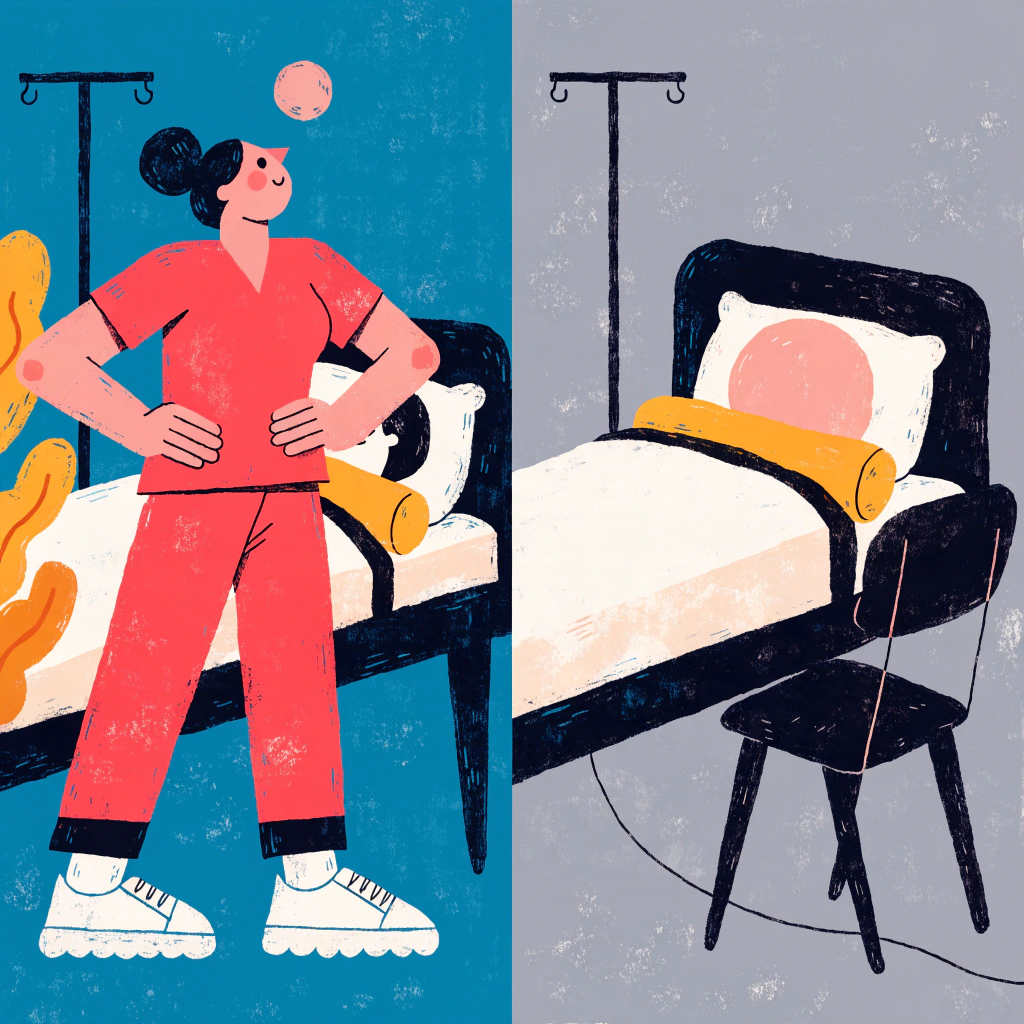
What Happens to Patients When Hospitals Are Short-Staffed?
Most conversations about hospital staffing shortages focus on the workforce side.
Why nurses are leaving. How to recruit more effectively. What the financial cost of a vacancy looks like.
These are important questions. But they tend to leave the most direct question unasked.
When hospitals are short-staffed, what happens to patients?
What the Research Shows
Matthew McHugh, Professor at Penn Nursing and Director of the Center for Health Outcomes and Policy Research, has spent decades studying the relationship between nurse staffing levels and patient outcomes.
In 2021, McHugh, Linda Aiken, and colleagues published a prospective study in The Lancet examining what happened in Queensland, Australia after minimum nurse-to-patient ratio legislation was implemented in 2016.¹ The study compared 27 hospitals subject to the ratio policy against 28 similar hospitals that were not, at two points in time: before implementation and two years after.
The findings were consistent with prior evidence. Compared to hospitals without mandated ratios, the hospitals with minimum staffing requirements showed significantly lower mortality, fewer 30-day readmissions, and shorter length of stay.
The conclusion from the research team: minimum nurse-to-patient ratio policies represent a feasible approach to improving nurse staffing and patient outcomes, with a favorable return on investment.
A related body of work by McHugh and colleagues has also shown that hospitals with higher nurse staffing levels are less likely to receive CMS readmission penalties — connecting staffing directly to financial accountability, not just clinical outcomes.²
When a Position Opens, the Research Doesn't Pause
McHugh's research establishes a relationship between staffing levels and patient outcomes. What it does not examine is how the hiring process affects those staffing levels over time.
When a nurse leaves and a position opens, the unit operates with fewer staff. The 2026 NSI National Health Care Retention and RN Staffing Report found that the average time to recruit an experienced RN is 78 days.³ During that period, a staffing gap exists. And as McHugh's research suggests, staffing levels are associated with patient outcomes — meaning that the longer a position stays open, the longer a unit may operate under conditions that the evidence links to less favorable outcomes.
The decisions that determine how long a vacancy lasts are not made automatically. They are made by clinical leaders reviewing candidates, submitting interview feedback, and approving offers — often from the floor, between patient responsibilities. When those decisions are delayed, the vacancy period may extend. And as the evidence suggests, that extension may have implications beyond the HR dashboard.
How Regulators Are Responding
In January 2026, the Joint Commission formalized this connection in a new way.
Nurse staffing was designated as National Performance Goal 12 — elevated for the first time as an independent patient safety performance goal under accreditation standards. Previously, staffing expectations existed across multiple standards but had never been consolidated as a standalone measurable goal tied directly to patient safety.
As the Joint Commission noted, this shift reflects the substantial evidence demonstrating a direct relationship between inadequate nurse staffing and increased mortality, preventable harm, and staff turnover.
The NPG 12 designation suggests that extended vacancies should be viewed not only as an operational concern, but also through the lens of patient safety accountability. What that means for hiring processes is a question hospital leaders are beginning to ask.
The Question the Research Has Not Yet Asked
McHugh's work establishes that staffing levels are associated with patient outcomes. What remains largely unstudied is how the speed of the hiring process influences those staffing levels — and by extension, what a faster or slower hiring process might mean for the patients in units waiting to be fully staffed.
If a vacancy is filled in 60 days rather than 78, does the difference in staffing stability show up in outcomes? If the average hospital is running with 43 unfilled RN positions, how much of that gap is driven by delays in the decision stages of the hiring process rather than a genuine absence of candidates?
Staffing is closely connected to patient outcomes. And how long a staffing gap persists may depend, in part, on how quickly hiring decisions are made.
That is the question McHugh's research opens — and one the field has not yet fully examined.
Sources
- McHugh MD, Aiken LH, Sloane DM, Windsor C, Douglas C, Yates P. "Effects of nurse-to-patient ratio legislation on nurse staffing and patient mortality, readmissions, and length of stay: a prospective study in a panel of hospitals." The Lancet. 2021;397(10288):1905–1913. https://doi.org/10.1016/S0140-6736(21)00768-6
- McHugh MD, Berez J, Small DS. "Hospitals with higher nurse staffing had lower odds of readmissions penalties than hospitals with lower staffing." Health Affairs. 2013. Via Penn Nursing CHOPR: https://www.nursing.upenn.edu/live/profiles/92-matthew-mchugh
- NSI Nursing Solutions, Inc. 2026 NSI National Health Care Retention & RN Staffing Report. March 2026. https://www.nsinursingsolutions.com/documents/library/nsi_national_health_care_retention_report.pdf
- The Joint Commission. 2026 Hospital National Performance Goals — NPG 12. https://www.jointcommission.org
- Dinsmore & Shohl. "Joint Commission Mandates Nurse Staffing as National Performance Goal for 2026." February 2026. https://www.dinsmore.com/publications/joint-commission-mandates-nurse-staffing-as-national-performance-goal-for-2026/