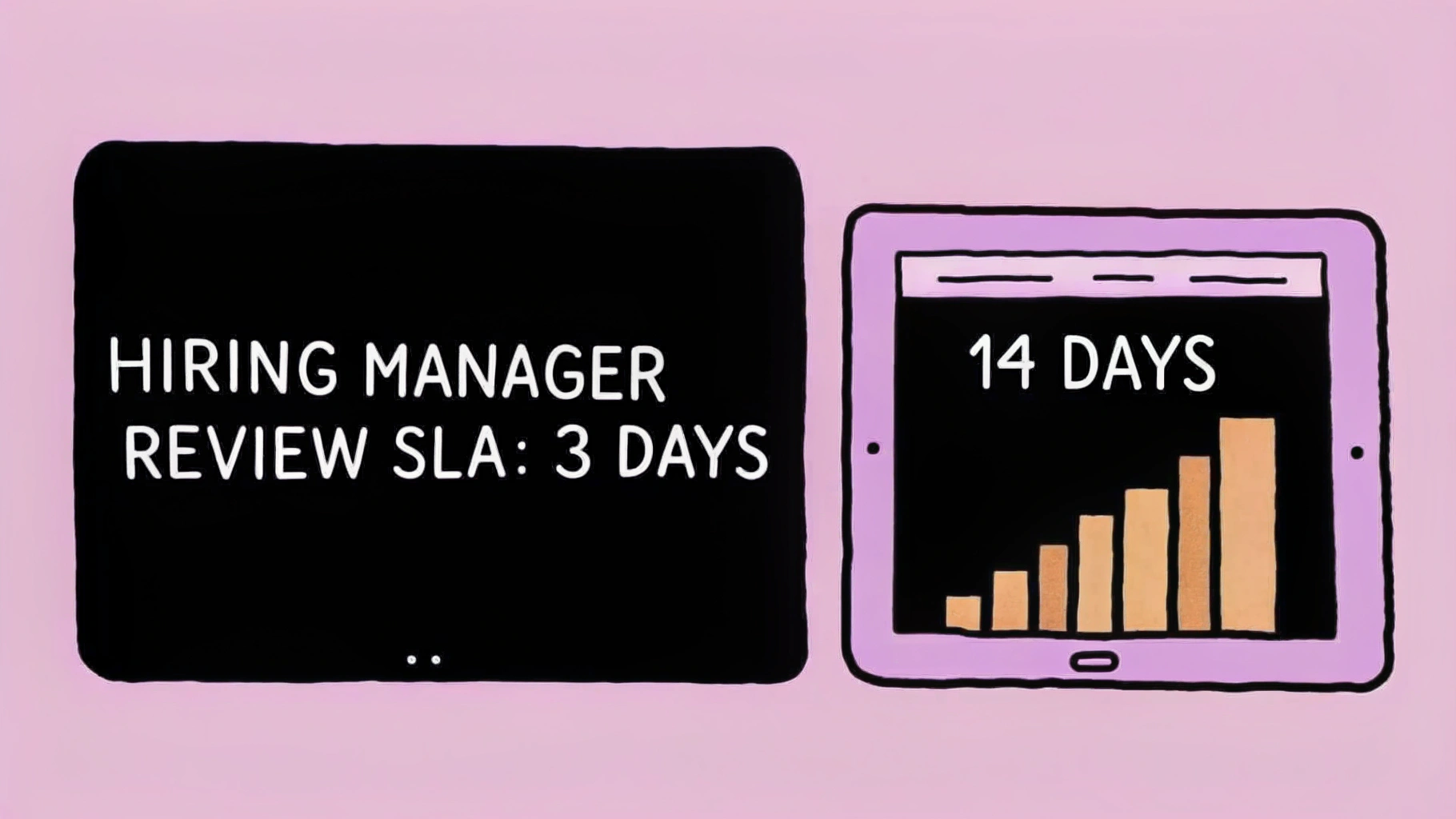
Your SLA Says 3 Days. Your Data Says 14. Here's Why Enforcement Is the Missing Piece.
Most hospital talent acquisition teams have defined SLAs for their hiring process. Three days for hiring manager review. 48 hours for interview scheduling confirmation. 24 hours for offer approval sign-off.
Pull the actual data and the picture looks different.
Hiring manager review: 11 days average. Interview scheduling: 8 days. Offer approval: 6 days. Total elapsed time from candidate submission to offer: 42 days, against a target of 12.
The SLAs exist. The performance doesn't match them. And in most cases, nobody is quite sure why — because the data that would explain it either doesn't exist or isn't being surfaced in a way that points to a specific owner.
This gap between stated SLA and actual performance is one of the most common and most expensive problems in hospital talent acquisition. And it has a specific name: the accountability gap.
Why SLAs Fail in Practice
A service level agreement is only as strong as the mechanism that enforces it.
In healthcare hiring, SLAs are typically defined during strategy sessions, documented in process guides, communicated during hiring manager training, and then left to operate on the honor system. When a hiring manager misses a three-day review window, the consequence is usually nothing. A recruiter might send a follow-up message. Sometimes that message gets a response. Sometimes it doesn't.
Without a structural enforcement mechanism — something that automatically triggers when an SLA is breached and requires a response to close the loop — SLAs become aspirational rather than operational. They describe what the organization intends to do, not what it actually does.
According to GoodTime's 2026 Hiring Insights Report, talent teams spend 38% of their time on interview scheduling alone, and 27% of TA leaders report that their teams face unmanageable workloads. A significant portion of that burden is the manual follow-up work that fills the gap where enforcement should exist.
The Recruiter as Enforcement Mechanism
In the absence of structural enforcement, the recruiter becomes the enforcement mechanism.
They track which hiring managers have reviewed candidates and which haven't. They send reminder messages. They escalate to HR leadership when reminders go unanswered. They schedule follow-up calls. They document the delays in notes that nobody reads.
This is coordination fatigue, and it has a measurable cost. Every hour a recruiter spends chasing a hiring manager is an hour not spent sourcing, screening, or building talent pipelines. GoodTime's data confirms that 60% of companies reported increases in time-to-hire in 2024, while recruiter workloads rose 26% in Q4 of that year.
The recruiter is being asked to do two jobs: talent acquisition and process enforcement. Neither job gets done as well as it should as a result.
What Visibility Without Enforcement Looks Like
Most modern ATS platforms offer dashboards that show where candidates are in the pipeline and how long they've been sitting in each stage. This visibility is genuinely useful for identifying patterns over time. It's not useful for preventing a specific candidate from dropping out while a hiring manager takes fourteen days to open a review tab.
Visibility shows you what happened. Enforcement changes what happens.
The distinction matters because the typical response to a visibility gap is to invest in better reporting — more detailed dashboards, more frequent pipeline reviews, more meeting time spent discussing where things are stuck. These investments produce better data about a problem that continues to exist.
The investment that actually reduces the gap is enforcement: a mechanism that triggers automatically when an SLA is breached, that reaches the responsible owner directly, and that records the response or non-response in a way that creates accountability over time.
The Three Levels of Accountability That Most Systems Miss
Effective hiring accountability operates at three levels, and most HR systems only support the first.
Level 1 — Visibility. Who owns this stage? How long has it been here? What's the SLA? Your ATS provides this, or should.
Level 2 — Intervention. When the SLA is breached, what happens automatically? Most systems: nothing, or an email that gets ignored. What should happen: a direct, structured action request to the responsible owner via their preferred channel.
Level 3 — Consequence tracking. Over time, which hiring managers consistently miss SLAs? What does their pattern look like across multiple requisitions? This data is what makes accountability conversations possible — not accusatory, but factual.
Most hospital TA teams have Level 1 in place and are trying to manually replicate Level 2 through recruiter follow-up. Level 3 barely exists because the data needed to support it isn't being captured in a structured way.
How Enforcement Changes the Dynamic
When a hiring manager knows that an SLA breach will trigger an automatic intervention — not a passive reminder, but a structured action request that lands on their phone and requires a response — the dynamic shifts.
It's not punitive. It's structural. The system treats a missed SLA the same way every time, regardless of how busy the hiring manager is or how comfortable the recruiter feels about following up. The accountability is built into the process rather than delegated to an individual.
Internal testing shows that when hiring managers receive a mobile action request with full candidate context attached, they respond within 48 hours on average. Compare that to the 14-day average that's common when hiring managers are expected to proactively log into an ATS and take action on their own timeline.
The SLA doesn't change. The enforcement mechanism does. And that's what closes the gap between the number in your process document and the number in your actual data.
Starting With the Data You Have
You don't need a new system to start measuring this gap. You need three numbers from your existing ATS:
- Your stated SLA for hiring manager review (in days)
- Your actual average time-in-stage for hiring manager review over the last 90 days
- The number of open requisitions currently past their SLA at that stage
If you don't have number two or three readily available, that's a Level 1 problem — and fixing it is the first step. Most ATS platforms can surface this data with the right filters applied.
Once you have the gap quantified, you have the business case for an enforcement layer. The dollar value of that gap is the number of past-SLA days multiplied by the daily cost of a vacant role — a number that becomes very persuasive in a room with finance leadership.
[Check your hiring velocity score with our free 2-minute assessment →]
Sources
-
GoodTime: 2026 Hiring Statistics Report
https://goodtime.io/blog/talent-operations/hiring-statistics/ -
GoodTime: 2025 Hiring Insights Report
https://goodtime.io/resources/report-hiring-insights-2025/ -
Mitratech: What 2025 Time-to-Fill Benchmarks Reveal About Hiring Agility and Risk
https://mitratech.com/resource-hub/blog/what-2025-time-to-fill-benchmarks-reveal-about-hiring-agility-and-risk/ -
iCIMS: Time to Fill vs Time to Hire — Key Metrics Explained
https://www.icims.com/blog/time-to-fill-vs-time-to-hire-key-metrics-explained/ -
SHRM: 2024 Talent Trends Report
https://www.shrm.org/content/dam/en/shrm/research/2024-talent-trends-research-overall-findings.pdf -
The Interview Guys: State of the Hiring Process in 2025
https://blog.theinterviewguys.com/state-of-the-hiring-process-in-2025/