AI Can Automate Recruiting. It Can't Make the Hiring Manager Decide.
AI in hiring is no longer a future trend. It is already part of how people apply and how employers respond.
A recent BBC News report, "Everyone's using AI to get hired. Now what?"¹, looks at what happens when both sides of the market use the same technology. Its central questions are about fairness and the candidate experience. This article asks a different one: what happens to the hiring decision itself?
Both Sides of the Hiring Market Now Use AI
On the candidate side, AI helps people find openings, adjust their CVs to each job description, and write far more applications than they could by hand. The BBC report cites a survey in which 73% of students and graduates said they use AI at some stage of applying for jobs.¹
On the employer side, the picture is less clear. The report notes that 75% of candidates believed AI was screening their CVs, while 21% of recruiters said they actually used it.¹ Whatever the true figure, the perception matters: applicants now assume a machine reads their application first.
The result, as the report describes it, is something close to an arms race. Graduate applications per vacancy rose from 38 twenty years ago to 140 last year.¹ More applications, more automated screening, and a growing feeling that AI is reading AI.
These figures are as cited in the BBC report and describe the UK graduate market. They are used here to illustrate a broader pattern, not as hospital data.
More Applications Do Not Mean Easier Decisions
A recruitment executive interviewed in the report makes a point worth pausing on. When applications are generated from the job description, they tend to look alike, which makes it harder to see a candidate's real skills. Verifying those skills is still done by people.¹
The report's conclusion is measured. Technology can process volume quickly and consistently. But deciding who is the right candidate still depends on human judgment.¹
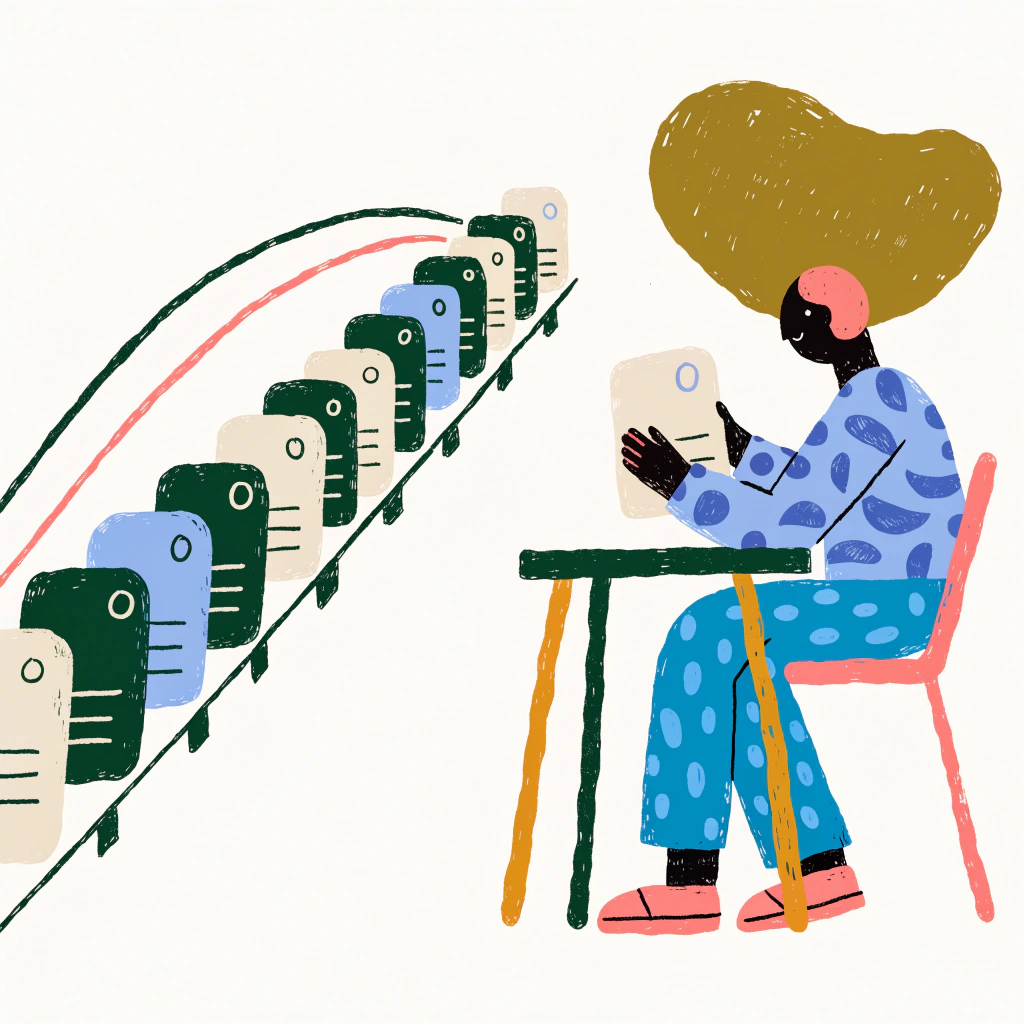
That distinction is easy to miss. AI can narrow 500 applicants to 20. It does not decide which of the 20 moves forward, how an interview went, or whether to extend an offer.
The More We Automate Around the Decision, the More the Decision Matters
Most of the stages AI has improved are administrative: sourcing, screening, scheduling, document collection. The stages that remain are judgment stages:
- Whether to interview this candidate
- What the interview showed, recorded as a scorecard
- Whether to select the finalist and approve the offer
These are the four decisions between a candidate and an offer, and none of them can be handed to software without losing the point of making them.
This creates a quiet paradox. When automation works, more candidates can reach the decision stage, and they can reach it faster. If the speed of the decision does not change, the bottleneck does not disappear. It moves.
What This Means for Hospital Hiring
In hospitals, the people who make these decisions are clinical leaders: nurse managers, directors, department heads. Their primary job is running a unit and caring for patients. Hiring decisions fit in between.
The data suggests where time tends to go. NSI's 2026 report puts the average time to recruit an experienced RN at 78 days, with an average of 43 unfilled RN positions per hospital.² GoodTime's 2026 healthcare hiring report finds that interviewer availability and delayed scorecards are consistent brakes on hiring speed, not candidate supply alone.³
These sources do not prove that automation causes decision delay. They do show that interviewer availability and delayed scorecards remain important constraints on hiring speed. As more of the earlier process becomes automated, those human decision points deserve more attention. The time lost at them has a name: decision latency, the time between a decision being needed and being made.
The Opportunity Is Not to Replace the Decision
Nothing here is an argument against AI in hiring. The BBC report is clear that AI can help both candidates and employers when it is built and used well.
The opportunity is to spend human time where human judgment is needed, and less of it on waiting, chasing, and logging in. A clinical leader's judgment about a candidate is the part of the process that cannot be automated. The operational friction around giving that judgment can be reduced.
AI can automate recruiting. It cannot make the hiring manager decide. What technology can do is make that decision easier to reach, easier to act on, and easier to measure.
FAQ
Does AI make the hiring decision?
AI is increasingly used to screen, rank, schedule, and support recruiting decisions. But the final decision about whether to interview, select, or hire a candidate generally remains with people, and the BBC report notes that deciding who is the right candidate depends on human judgment.¹
Why does human judgment matter more as hiring becomes more automated?
Automation increases the number of candidates who can be processed and the speed at which they arrive. The decision stage then becomes the step that sets the overall pace, and verifying real skills still requires a person.
Is AI screening good or bad for hiring?
The BBC report presents both sides. AI can process volume consistently and help candidates and employers find each other, but it raises questions about fairness and about whether real skills are visible. How it is built and used matters.¹
What does this mean for hospital hiring?
Hospital hiring decisions sit with clinical leaders who are also running units. As earlier stages speed up, the time between a decision being needed and being made can be an important constraint on filling a role.²³
Sources
- BBC News. "Everyone's using AI to get hired. Now what?" YouTube. https://www.youtube.com/watch?v=JulfdGi0qMw
- NSI Nursing Solutions, Inc. 2026 NSI National Health Care Retention & RN Staffing Report. March 2026. https://www.nsinursingsolutions.com/documents/library/nsi_national_health_care_retention_report.pdf
- GoodTime. 2026 Healthcare Hiring Trends Report. https://goodtime.io/blog/recruiting/healthcare-hiring-trends/